Translate

Wednesday, 19 May 2021

CV19 Vaccination Residents

 The Ministry of Health of the Government of the Canary Islands informs that people residing in Fuerteventura who this year turn between 50 and 59 years old will be summoned in the next few days to receive the vaccine against COVID-19.

Thus, the Canary Islands Health Service (SCS) has activated several complementary systems such as sending SMS and summons from health centers or vaccination centers.

In addition, in a complementary way and to speed up vaccination in a part of this age group, people over 55 years of age living in Fuerteventura who have not been cited may call 928 423 516 to request their prior appointment.

The purpose is to vaccinate the most vulnerable groups as soon as possible, as stated in the Vaccination Strategy against COVID-19.

To do this, citation systems have been combined that promote coverage of priority groups, since the arrival of vaccines regularly, together with the opening of massive vaccination centers allow to intensify the inoculation of target groups and progress in the inoculation in this age group.

Progressively, the lines of citation will be opened for other age groups.

Tuesday, 11 May 2021

Massage

 Anyone who would like a home massage can contact Tammi on +34632844277. The cost is €25 per hour. Sports and general massages for back pain etc!

Friday, 30 April 2021

April 30th New Covid19 Alert Levels

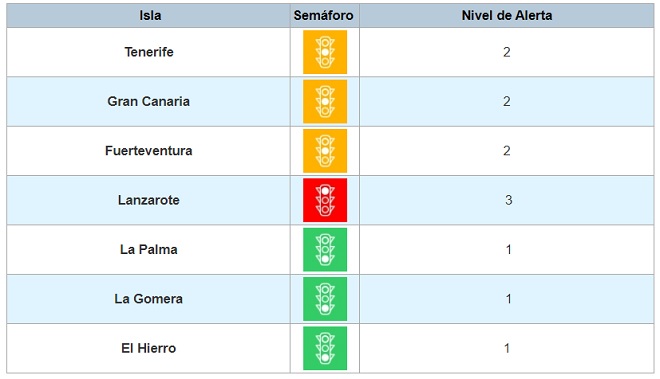
 The Ministry of Health has agreed this Thursday April 29th, after the analysis of the epidemiological indicators, to lower the island of Gran Canaria to alert level 2 (it was at 3) and that of Fuerteventura to alert level 1 (it was at 2) . El Hierro, Lanzarote and La Graciosa remain at level 2, and La Palma and La Gomera, at level 1.

In addition, the Governing Council has agreed that the Ministry of Health review next Tuesday, May 4, the indicators of Tenerife, to check if it is already possible to change the level from 3 to 2, provided that the current trend of improvement on that island.

In the case of the island of Tenerife, to date, the indicators mark its permanence at level 3. However, the Governing Council held this Thursday has urged the Ministry of Health, through its General Directorate of Health Public, to a review next Tuesday, May 4, of the epidemiological and care levels on that island, given the downward trend of all of them in recent days. It will be then when it is determined if the change of level in that island proceeds, which would take it from level 3 to 2.

The level changes will come into effect coinciding with the weekly update of the Accumulated Incidence Stoplight (IA), published on the website of the Ministry of Health. That decision is based on the report issued by the General Directorate of Public Health of the Canary Health Service (SCS) dated this Thursday. This report, in the case of Tenerife, indicates a daily average of 97 diagnoses. The 7-day AI on that same island has been decreasing to around 62 cases per 100,000 inhabitants today.

The behavior in the older age groups is parallel and the value of the rates is higher than that of the Autonomous Community as a whole. There is an expectant attitude to the consolidation of the value of the 7-day AI rates, so it is proposed to continue at alert level 3 for Tenerife, until the new test on Tuesday, May 4.

For Gran Canaria, the report includes that the AI ​​indicators at 7 and 14 days are at medium risk in the last 14 days, which indicates a certain stabilization of the risk of community transmission, the same as in the population aged 65 and over . In addition, the data suggest a downward trend, with an average of 53.3 cases per 100,000 inhabitants. Therefore, it is proposed to descend to alert level 2.

However, the report states that this recommendation requires the collaboration of all citizens and institutions in complying with non-pharmacological measures, to avoid reversing this evolution and causing a rapid and uncontrollable increase in the number of cases.

With regard to Fuerteventura, a favorable trend is also confirmed in the indicators, which position it at alert level 1. The rates of AI at 7 and 14 days have remained at risk of medium transmission in the last two weeks and people aged 65 and over years have declined to low risk levels. However, the report states that close surveillance will have to be exercised in certain tourist centers of repeated non-compliance with prevention measures, which could become potential sources of transmission.

In the case of Lanzarote, the 7-day AI rate in this period is 48.5 cases per 100,000 inhabitants and it is proposed that it remain at alert level 2. The island of El Hierro also remains at this level, where in the In the last week there have been 18 new cases, with a total of 46 for the period analyzed, although since the 22nd the number of diagnoses in people 65 and over has fallen. This implies that the 7-day AI rates have been decreasing in recent days, but remaining at very high risks, not the case for those aged 65 and over, which has fallen solidly, according to the same report.

The island of La Palma, with 36 new cases in the last two weeks, presents a 7-day AI rate of 12.6 cases per 100,000 inhabitants, low risk, although in the last two days, in which they have been diagnosed In 20 of these cases, the rate has risen to medium risk. There are only two people admitted to the ICU. It is proposed that it remain at level 1. In the case of La Gomera, with two new cases, it presents incidents that indicate a minimal risk of community transmission and remains at level 1.

Thursday, 15 April 2021

Update Cov19 Level

 The Governing Council of the Canary Islands has agreed this Thursday to maintain the alert levels for covid-19 in all the islands, except Fuerteventura, which drops from level 3 to level 2.

Thus, Tenerife and Gran Canaria continue at level 3, (red traffic light), Fuerteventura and Lanzarote at level 2 (orange traffic light) and La Palma, La Gomera and El Hierro at level 1 (green traffic light).

"In Gran Canaria and Tenerife there is still worrying data, there is a line that we cannot reduce," said the Government spokesman, Julio Pérez, who has announced that a general review of the table of restrictive measures in force for each level based on experience and technical criteria.

Pérez recalled that this general table of measures, which was drawn up last June, includes 70 different measures and has pointed out that the experience in these months as well as the suggestions of the sectors will allow a "rereading" of them and decide the modification of some and the continuity of others.

Regarding the epidemiological situation of Tenerife and Gran Canaria, the government spokesman said that the seven-day incidence has been increasing in both islands and has alluded to other worrying parameters such as that it has increased, not only infections, but the occupation of ICUs Among other reasons, because the stay of patients in these areas has increased compared to the beginning of the pandemic.

Pérez has acknowledged that the Government of the Canary Islands is wondering if there will be any other more effective measure to reduce the trend of infections but has stressed that these same restrictions have worked at other times and now they have done so in Fuerteventura, which has allowed it to decrease of level.

However, the also Minister of Public Administrations has indicated that the effects of the vaccines "seem to begin to be visibly noticeable" given that contagions have been reduced between the groups already vaccinated with the two doses, which are groups 1 and 2.

"It is a relevant fact and without wanting to think that everything is resolved, it is a sign that the vaccine has positive effects," said Pérez, who has trusted that the same effect will occur in the following vaccination groups.

He has also detailed that the rate of vaccination has resumed and has specified that the problems in the delay caused with AstraZeneca, will be offset by the arrival of more Pfizer vaccines, although he did not know how to specify in what quantity.

Pérez recalled that in the Canary Islands between 16,000 and 17,000 people are being vaccinated a day although the estimates of the Canary Health Service is that if there are enough vaccines, that amount can be doubled.

He has also indicated that the figures for the use of doses in the Canary Islands are acceptable and has warned that the supply of vaccines in the national territory responds to the number of vulnerable people that exist in each community.

Friday, 2 April 2021

Mask wearing update 2nd April 2021

 The Government of the Canary Islands understands that the new regulations on the use of a mask in public spaces do not alter the exceptions approved in each autonomous community, which in the case of the islands protect whoever takes it off to sunbathe on the beach if they are in your towel and those around you are at a safe distance.

"The Canary Islands understand that the standards that it has used up to now are still covered by the new regulations" and "intensive use" is maintained in the application of the "new normal" law already in force that requires the use of the mask, even when the safety distance of 1.5 meters is maintained, said the spokesman for the regional Executive, Julio Pérez (PSOE).

However, he insisted, that general use of the mask does not cancel the exceptions set by the regional governments within their powers as health authorities in this pandemic.

In other words, the Canary Islands understand that in the case of beaches the rule by which it has been governed until now is still in force: the bather can remove the mask to enter the water, but also to sunbathe in a static place ( for example, your towel or lounger), as long as you can keep a safe distance.

"The Canarian regulations on the use of the mask is not a message of relaxation of use, people on the beach have the same obligation as until now, it is still mandatory," argued Pérez, who has once again asked citizens for responsibility in compliance with the rules against covid.

The law of urgent prevention, containment and coordination measures to face the health crisis caused by the covid was approved last Thursday by the plenary session of Congress, after the green light of the Senate, where an amendment was introduced -of the PSOE- that it established the mandatory nature of the mask even while maintaining the safety distance.

The text that reached the Senate and that was not previously modified in Congress established that people over six years of age are obliged to use the masks "on public roads, in open air spaces and in any closed space of public use or that is open to the public, as long as it is not possible to guarantee the maintenance of an interpersonal safety distance of at least 1.5 meters ".

With the amendment introduced in the Senate, the final part of the wording of the text regarding the safety distance was deleted, making the use of the mask mandatory even if that distance of 1.5 meters can be maintained.

However, the Government of the Canary Islands protects its interpretation of this law at the end of its article 6.2: "It will not be enforceable in the case of individual sport in the open air, nor in cases of force majeure or situation of necessity or when , by the very nature of the activities, the use of the mask is incompatible, in accordance with the indications of the health authorities ".

In his opinion, this mention of "the indications of the health authorities" keeps the exceptions issued by the Government of the Canary Islands in force.

And those exceptions to the mandatory use of the mask, in the regulations of the islands, are two:

1) In spaces of nature or outdoors outside population centers, as long as the influx of people allows maintaining an interpersonal safety distance of at least two meters.

2) On the beaches and swimming pools exclusively during bathing and while staying in a certain space, without moving, and provided that the respect of the interpersonal safety distance of at least two meters between all non-living users can be guaranteed.

The Canarian Executive spokesman has asked that "rigor be extreme in compliance with the measures now that the risk increases, there is more mobility, social life and family encounters" with Easter.

Likewise, Pérez has stated that "the vaccination process remains at very acceptable levels" and the figures "continue to be encouraging and only the speed of supplies darkens the prospects; if we had enough vaccines, we would achieve immunity soon."

It has also reported that the doses of Pfizer's vaccine scheduled for Monday are doubled and those of AstraZeneca are also increased next Friday

Monday, 22 March 2021

Fuerteventura Alert Level

 The fact that Fuerteventura goes to level three or red traffic light today, Monday has consequences . For example, the permanence of groups of people, both in public and private spaces, becomes a maximum of four individuals, except in the case that they are living together, two less than with level two.

One of the measures set by the autonomous community with the greatest impact - consult the full document here - is that with alert level three "the exit and entry of people is restricted" to the island, "except for justified displacements", as reasons professionals, assistance to medical or educational centers.

However, the Minister of Health, Blas Trujillo, announced this Thursday that, for Easter, between March 26 and April 9, mobility between islands is restricted, except for the stipulated exceptions . In order to move beyond the exceptions, a negative diagnostic test will be required.

The curfew with the red traffic light is generally between 10 p.m. and 6 a.m., one hour less than with alert level two.

As for the hospitality industry, the most prominent measure is that they have to close the interior of the establishments, while the outdoor terraces have to limit their capacity to 50 percent, with four people per table.

Thus, bar consumption becomes prohibited, which with level two could be in groups of two people, and the complete closure of the establishment must take place before 10 pm.

In commercial establishments the maximum capacity is 33 percent inside the premises, and the use of recreational or children's areas is prohibited, "unless disinfection can be guaranteed after each use."

The markets that are held periodically have their capacity limited to 33 percent indoors and 50 percent outdoors (previously it was 50 and 75 percent, respectively).

Monday, 8 March 2021

Community Suggestion Box

A suggestion and complaints box has been installed next to the 'employees' room, in garage A so that all owners who wish to, can express themselves on Community issues. 

Fuerteventura CV19 Level

 Fuerteventura goes to alert level 2 before the evolution of its pandemic data

  • The Government establishes a curfew on the island between 11:00 p.m. and 6:00 a.m.

Traffic light updated this Thursday by the Government 

The Ministry of Health has agreed this Thursday, March 4, after analyzing the evolution of the indicators to raise the island of Fuerteventura from level 1 to level 2 and keep the rest of the islands at the same alert level as they were. In this way, Lanzarote and La Graciosa continue at alert level 3; Tenerife and Gran Canaria at alert level 2; and El Hierro, La Palma and La Gomera at alert level 1.

That decision is based on the report issued by the General Directorate of Public Health of the Canary Islands Health Service (SCS) this Thursday.

It should be remembered that since last Tuesday, March 2, the update of the prevention measures established by the Government Agreement of June 19, 2020, to face the health crisis caused by COVID-19, has been in force, once the Phase III of the Plan for the transition towards a new normality, as well as the determination of health alert levels (published in BOC No. 42, of March 2).

Alert level 2 (Fuerteventura, Tenerife and Gran Canaria)

Limitation of the freedom of movement of people at night. The freedom of movement of people is limited at night from 11:00 p.m. to 6:00 a.m. every day.

Capacity between non-cohabitants in public and private spaces. The permanence of groups of people is limited to a maximum of 6, except in the case of cohabitants. If the group includes both cohabiting and non-cohabiting people, it will not exceed 6 people.

Measures for the hotel and catering business, restaurants and terraces, bars and cafes. You may not exceed 75% of the authorized capacity in outdoor terraces and 50% in indoor spaces. The maximum occupancy per table or group of tables will be 6 people outdoors, 4 indoors and 2 for the group of customers at the bar. The buffet or self-service service cannot be provided indoors. The complete closure of the establishments is established before 23:00.

Sport practice. For collective activities in the interior areas of sports facilities and centers where it is not possible to maintain a safety distance of 2 meters permanently, a maximum number of 6 people per group is allowed, including the monitor. In addition, a safety distance of 2 m between the different groups will be guaranteed at all times. 50% of the capacity will not be exceeded for each of the rooms and sports centers.

Sports are allowed outdoors in groups of maximum 6 people, including a monitor, if the interpersonal safety distance of 2 meters cannot be maintained permanently. 75% of the sports capacity will not be exceeded in each of the sports spaces and centers. Non-professional federated sports activity is allowed in modalities with more than 10 people to exceed the maximum necessary exclusively for the development of the activity.

Public transport. In the regular public urban and metropolitan land passenger transport, its capacity is reduced to 50%. Surveillance of urban land transportation will be reinforced at peak times to avoid crowds. At peak times, avoid using public transport for non-essential or postponed trips.

Hospital centers and health care centers. In hospital centers, external visits are limited, remaining under the supervision of the center. In addition, the use of FFP2-type masks and face shields is recommended by personnel who have direct care with patients in these centers, as well as reinforcing ventilation

Tuesday, 26 January 2021

CAAF in the Media

 The new modules of the Gran Tarajal desalination plant generate annoying noises to the neighbors

  • The mayor of Tuineje and the councilor of Aguas del Cabildo visit the facilities and the island body undertakes to seek solutions

Carlos Rodríguez, Tomás Torres and Esther Hernández.
Diario de Fuerteventura 0 COMMENTS 01/25/2021 - 18:49

A few months ago, the desalination plant of the Consorcio de Abastecimiento de Aguas a Fuerteventura (CAAF) in Gran Tarajal saw its production capacity strengthened by the urgent incorporation of machinery that allowed it to face imminently supply problems in the south of the island .

However, this is causing inconvenience to residents of the area due to "the significant noise generated by these equipment." The mayor of Tuineje, Esther Hernández, together with the councilor of Waters of the Cabildo de Fuerteventura, Carlos Rodríguez, and the councilor of Waters, Tomás Torres, have visited the desalination plant of the Consortium.

The island councilor has announced that "the new water production modules will be installed inside the plant to reduce the current noise level."

"We must bear in mind that we are facing a facility collected within the water emergency that we declared to tackle the problems of water supply in the south of the island", Carlos Rodríguez clarifies.

For her part, the mayor of Tuineje thanked "the counselor's willingness to reconcile guaranteeing the water supply with minimizing the inconvenience to the neighbors around this plant.

Hernández also highlighted "the important effort made by the Cabildo and the CAAF in improving the water supply, with the replacement of the transport network to Tiscamanita."

For the Water Councilor of the Tuineje City Council, Tomás Torres, "ending the problem of water supply in the municipality, something that we have been suffering for years, has been a priority and a claim that this City Council has continuously and repeatedly brought to the CAAF ".

More than double the production

The Gran Tarajal desalination plant went from producing around 2,000 cubic meters per day to now standing at just over 5,000, "which, together with the replacement of transport networks, such as the one that goes to the Tiscamanita deposit, in addition to the sealing and cleaning that we have done in all the storage tanks; it allows us to advance towards the guarantee of water supply in the south of Fuerteventura "

Thursday, 14 January 2021

CAAF Petition

 Marianne, the VM secretary, is currently collecting names for a petition agaist the noise polution coming from CAAF water plant. If anyone wants to add their name to it, please get in touch with her or Fimax and let her know! 

AGM

 Just to let everyone know, the VM Annual General Meeting has been postponed until further notice, due to the CV19 limitations. 

Monday, 11 January 2021

New CV19 Rules

 The Tuineje City Council has also decreed this Monday, like the La Oliva City Council, a series of exceptional measures under the report of recommendations on additional restriction measures for the Fuerteventura Health Area in the face of the current epidemiological situation derived from the COVID-19 pandemic.

The measures are adopted "in accordance with the provisions of the agreement approving temporary specific measures in the area of ​​the autonomous community of the Canary Islands to face the health crisis, published in the BOC on January 9".

The measures have been decreed by the mayor Esther Hernández effectively from Monday, January 11, until next Monday, January 25, with the aim of stopping the contagion curve that the municipality of Tuineje has experienced in recent days.

Hernández has asked the population for an exercise of "individual responsibility and collective effort for the next fifteen days to regain normalcy in the municipality and stabilize the level of infections."

The decree of the mayor contemplates limitation of the freedom of movement of people at night between 10 pm and 6 am, except for essential activities.

The permanence of people both in spaces for public and private use, closed or outdoors, will be limited to cohabiting people, except in hotels and restaurants and respecting the maximum number of four users per table.

The hotel and catering establishments are also closed to the public before 10 pm, excluding cafeterias and restaurants in work centers for the exclusive use of workers.

Likewise, the number of diners per table will be four people and the service in interior areas is prohibited, excluding health centers, work centers for the use of their staff and those of tourist accommodation for the exclusive use of guests under the regime of accommodation.

Gambling casinos, bingo halls, arcades and games rooms, external betting venues and other similar venues will remain closed.

The practice of non-professional physical and sports activity is allowed in the interior areas of sports facilities and centers, with strict compliance with the usual security measures in the face of COVID-19, being prohibited the public attendance to them.

The practice of non-professional sports activity and physical exercise in the open air can be carried out individually and as long as the interpersonal safety distance of two meters can be maintained permanently.

Team sports or those practices or exercises in which the maintenance of said distance cannot be guaranteed at all times may not be practiced.

In the regular urban and metropolitan public land transport of passengers its capacity is reduced to 50 percent.

In addition, the closure of cultural centers and library is also established.

Thursday, 7 January 2021

Water

 Anyone who read a post yesterday regarding Water please note that this message has now been cancelled.